
Historical article . References to tools and versions reflect the time of publication.
Christmas coincides with the end of the year, making it a good opportunity to analyse the past year's leading trends and base your campaigns on them.
Speaking hypothetically, using 2014 as a reference and measurements based on Google Trends, the three leading Internet trends in 2014 were:
Trend 1: Video
Videos now account for 90% of all Internet traffic.
Facebook users watch a total of 500 years' worth of video every day.
The number of YouTube visitors has grown to 1 billion a month.
Trend 2: Social Media
77% of Internet users have an account on at least one social network.
These same users are 4 times more likely to buy a product when a friend recommends it.
Social networks are now an essential part of the consumer journey.
Trend 3: Mobile
38% of all searches are now made on smartphones.
Smartphone users represent 60% of the population.
Why should we start changing our seasonal campaigns early?
People generally complain when supermarkets start playing Christmas songs in mid-September. The truth, however, is that consumers prepare for the big day much earlier.
23% have already started buying gifts by mid-November.
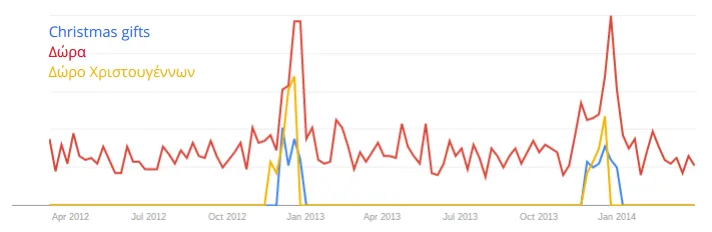
Google Trends shows that Internet users begin researching Christmas gifts several months before Christmas.
84% of consumers do extensive research online before making a purchase. This shows how important online search is during the Christmas period. It becomes more important as time goes on.
Seasonal schedule
It is therefore time to increase your visibility. From now until the end of the year, you should consider doing the following:
October:
Time to make sure people can find you, so:
– Enable your ads for smartphones and tablets.
– Use remarketing tags on your website.
– Focus on your most popular products.
October and November:
– Respond to market changes and adjust your bids and budgets daily.
– Set up your remarketing campaigns.
December:
There is still plenty of opportunity to reach your audience, so make your ads more interesting by adding details of any offers you have.
-Use location extensions to show shoppers where to find you.
-Adapt your keywords to a Christmas theme.
Fine-tuning your Christmas campaign with Google Shopping
Google Shopping offers a simple, flexible way to organise your product catalogue, adjust your campaigns accordingly and connect easily with your customers on all devices.
Make sure you follow the basic principles of Google Shopping:
Bid according to your goals and competition:
– Use benchmark and impression share data to set your best bids
– Bid more and increase budgets when you expect traffic peaks or changes in demand.
Make things easier for shoppers on mobile devices:
-Bid higher for queries from people near your store.
– Simplify shopping and checkout.
– Do not forget mobile tracking.
Create high-quality feeds and keep them up to date:
– Use relevant titles, descriptions and images to improve CTR without creating keywords.
– Keep your feed accurate and up to date.
Structure your campaigns as you would structure your store's front page:
– Promote seasonal items in a separate campaign.
– Use multiple campaigns and priorities to promote quick sales.
Also,
- Improve the quality of your data feed and create content specifically for the holidays.
- Plan your holiday strategy to take advantage of the extended shopping period and increased traffic.
- Take advantage of merchant promotions and certified stores to stand out this season.
- Connect with shoppers on mobile devices by increasing your mobile investment.
- Upload your product catalogue online to drive more people to your stores.
- Put your entire product catalogue in the feed and make sure you remain competitive when promoting your offers: the competition always wants to capitalise on the Christmas season.
Fine-tuning your Christmas campaign with mobile advertising
Online search is moving from desktop to mobile:
Mobile search is the starting point for 65% of consumer journeys.
Afterwards, 61% continue their search on a desktop computer and only 4% on a tablet.
You need to ensure that you display correctly on smaller screens.
- 69% of smartphone users search for product information on their phones
- 57% of smartphone users search for local information at least once a week
- 37% of smartphone searches lead to a purchase from a local store.
Fine-tuning your Christmas campaign with mobile advertising
Top tips for mobile advertising:
– Make sure your ads are visible in the highest positions in mobile search results by increasing your bids.
– Adapt and optimise your landing page for mobile devices to improve the visitor experience.
- 85% of Internet users only look at the highest positions in search results.
- 70% of smartphone users expect websites to work equally well on their mobile device and computer.
Fine-tuning your Christmas campaign with mobile advertising
You can advertise on mobile devices using Google Search, the Google Display Network and even YouTube.
These are the most common extensions for mobile advertising on Google Search:
Location Extensions
Location Extensions add an extra line to your ad, highlighting your store's location. They allow your customers to get directions to your business immediately. Advertisers see an average CTR increase of 10% from location extensions.
Call Extensions
Call Extensions let you add a phone number to your ad, making it easier for customers to call you directly. Call extensions also provide a detailed report of the calls you receive from your ads. Advertisers see an average CTR increase of 6–8% from call extensions.
Mobile Bids
Use performance data to adjust bids by location and increase your visibility when customers are near one of your stores. You can also adjust bids for specific times and devices when customers are likely to move between devices during the shopping period.
Take advantage of demand for mobile shopping and bring people into your store with mobile bids and extensions during the holidays.
Fine-tuning your Christmas campaign with Remarketing
Most people need time before making a purchase, especially when buying gifts for loved ones. This means that a single visit to your website may not be enough.
Remarketing is a good way to persuade an undecided consumer to choose you. Use it to boost sales and complete the purchase cycle by reaching previous visitors to your website.
- 96% of visitors leave the website without making a purchase
- 70% of customers abandon their purchase after placing products in their basket
- 49% of consumers typically visit 2–4 websites before making a purchase
Essential remarketing tips:
- Find previous visitors to your website and turn them into buyers across the Internet and on all devices, using the reach of Google's inventory.
- Tailor your message to each user based on the pages, products and content they chose to view on your website.
- Use AdWords Remarketing Lists for search ads. RSLA improve performance by adapting keywords, bids and creative based on a user's previous activity on their websites.
The broad term “gift” is usually extremely popular in November and December, which means a higher cost per click and a lower return on investment. - Use dynamic remarketing. The holiday period brings a lot of traffic, and Dynamic Search Ads let you drive additional traffic to your website without having to create long keyword lists.
- Use mobile remarketing. If your website is not suitable for mobile devices, simply choose to have your campaigns displayed on mobile devices.